
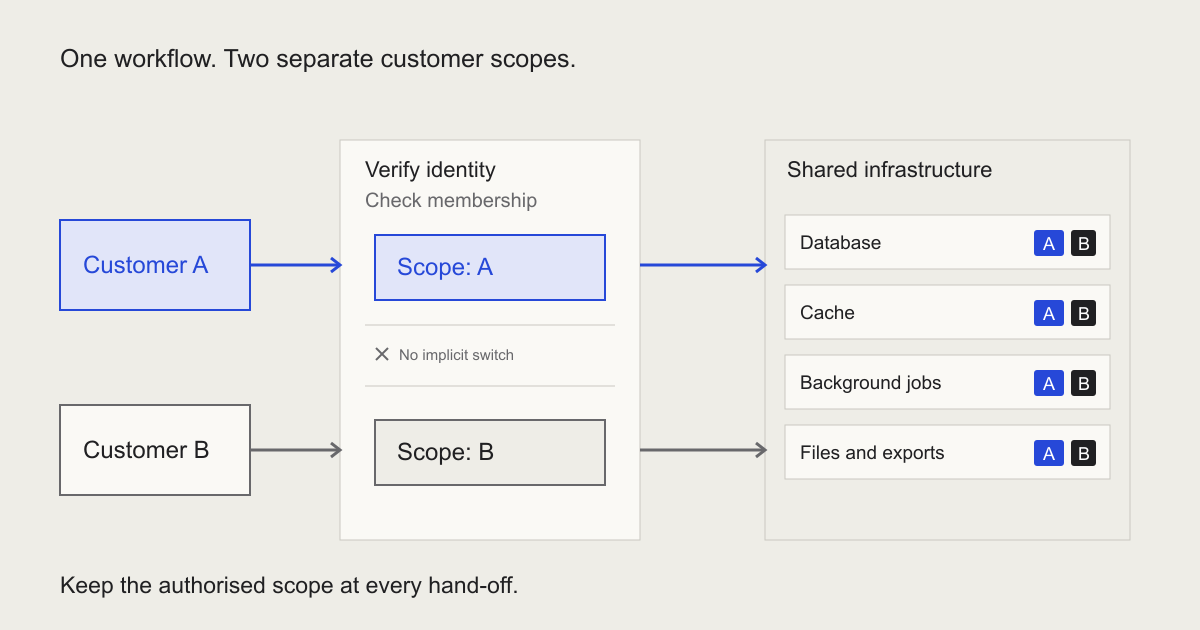
A prospective enterprise customer asks how you isolate its data. Your product has organisations, separate logins and a tenant_id on every invoice. Before answering, ask the team to trace a request for an invoice belonging to a different organisation. The result gives you something concrete to discuss with the buyer.
A tenant is the customer organisation whose access you need to separate. AWS's SaaS Lens describes isolation as preventing one tenant from accessing another tenant's resources, with the implementation depending on the architecture. A founder's decision is which promise the product can support today and what needs engineering work before signing a larger deal.
I would ask for a short review covering the promise, the evidence and the ongoing cost. Sales, engineering and support should be able to use the same answer.
Write down what the customer is asking for
Ask the buyer to describe the requirement in operational terms. Must employees of another customer be unable to read the data? Does the buyer require a dedicated database, a particular hosting region or control over support access? These requests lead to different designs and costs. A single yes in a questionnaire can conceal several separate commitments.
Then describe the current product plainly: which infrastructure is shared, how customer access is enforced and which administrative roles have wider access. Keep data access and performance commitments separate. A customer might accept shared infrastructure while still expecting a large export from another account to leave its service responsive. Agree on what the review needs to demonstrate before discussing a new architecture.
Compare options your team can keep running
Shared tables, separate schemas and separate databases are possible starting points. Compare them against the actual requirement and the team's ability to operate them. For a small product, shared tables can simplify deployment while requiring careful enforcement throughout the application. Dedicated databases add provisioning, connection management and upgrade work. Neither choice resolves every path through shared application code.
If the proposal is a dedicated deployment, ask who will patch it, monitor it and recover it when that customer's environment fails. Work through an ordinary product release: how does the team know which customers received the migration, and what happens when one deployment falls behind? Put this recurring work beside the initial build estimate.
Choose the smallest change that satisfies the agreed requirement and can be verified. A platform rewrite needs its own justification. One enterprise opportunity is enough reason to investigate a boundary; it is not evidence that the whole product needs replacing.
Use two test organisations and record the result
Create two organisations with synthetic records that are easy to distinguish. Give each a normal user and make a short acceptance exercise from the product's real workflows. Include reading an invoice, changing it and generating an export. State what each user should be allowed to do before running the exercise.
Use the second organisation's record identifier in a request made by the first organisation's user. Check the response and whether any stored data changed. Repeat after switching organisations and after removing a user's membership. This is an authorised test in a controlled environment with disposable data.
Keep the evidence with the release that was tested. A screenshot of a hidden menu says little about a direct API request. The useful record identifies the role, the action, the expected boundary and the observed result. Add the important cross-account cases to the release checks so the team can repeat them after a change.
Follow the export after the request ends
OWASP's multi-tenant guidance covers caches, asynchronous work and file storage as well as database access. A tenant identifier in an untrusted request or message is insufficient authority.
Take the export from the acceptance exercise and draw its route: request, job, data read, stored file and download. At every hand-off, ask who establishes the customer context, where access is checked and what evidence the team can inspect. Include support tooling in that drawing if support can retrieve the result.
Use this single workflow to find the next useful engineering task. If the team cannot explain who can download a completed export, adding a new database will not answer that question. Ask for a demonstrable correction to that path and repeat the exercise before expanding the review.
Run the database check with the application's role
PostgreSQL documents that superusers, BYPASSRLS roles and normally table owners bypass row security. Normal access is denied when row security is enabled without an applicable policy. Check these settings before relying on a policy.
Have the team exercise the policy using the database role and connection handling used by the application. Establish tenant context from verified identity and membership, and test reuse of a connection between organisations. An administrator's successful query does not show what a customer request can do. Keep administrative and support access explicit, with its own authorised purpose and evidence.
Include the exceptions in the decision
Before committing, put four items in the decision record: the requirement, the design chosen, the evidence still missing and a named operational owner. If a customer needs an exception, describe how it will receive upgrades, support and eventual offboarding. Someone needs time to carry that work after the sale.
Consider a request to restore just one customer's data while the rest of the product stays live. Ask the team to demonstrate the procedure in a test environment and estimate the work it creates. That discussion can change which isolation option is practical. A database layout is only part of the service you will have to operate.
A founder may decide that a narrowly scoped change fits the deal, or that the requested service needs different pricing and a later delivery date. An enterprise team may need to involve existing platform owners. Either decision is easier to defend when the cost and outstanding evidence are written down before the commitment.