CTO commentary by Ilya Ilin
NVIDIA announced on November 23 that its board had reinstated Jensen Huang as president, CEO and board director. Colette Kress continues as CFO after serving as interim CEO. For a founder buying AI capacity or an enterprise building on NVIDIA hardware, the announcement puts a familiar question on the agenda: how much does our product depend on one supplier?
Before approving a migration, I would ask the team to take one customer workflow through a different provider. Find out whether it works, what it costs and which dependencies stay the same. That gives the business something more useful than a second logo on an architecture slide.
Decide what would make you change course
The November 23 release announces a leadership decision. It does not report an outage or a change to customers’ computing capacity. A production migration needs an operational reason: capacity you cannot obtain, an unacceptable contract change, a workload that misses its deadline, or a requirement the current service cannot meet.
Write that trigger down with the person who owns the business outcome. If the current service still meets the requirement, keep shipping while you investigate an alternative. If a contract renewal is approaching, use the time to prove an exit and put its cost into the renewal decision. A hurried rewrite can introduce problems before it removes a dependency.
Find the supplier behind the cloud account
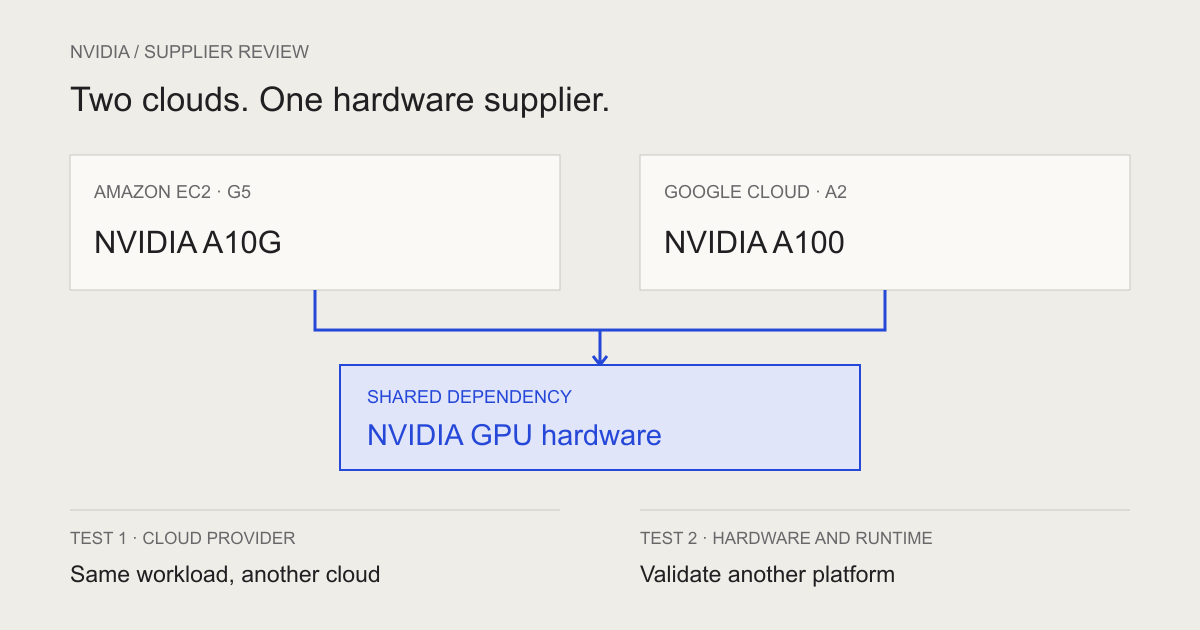
The name on your cloud bill tells you only part of the story. AWS lists NVIDIA A10G GPUs for its EC2 G5 family. Google Cloud’s A2 machines use NVIDIA A100 GPUs. Moving between those families changes the provider and the GPU model; NVIDIA remains in the hardware chain.
A second cloud can still be valuable for an account restriction, a regional problem or unavailable capacity. Whether it helps depends on the specific failure and on capacity actually available there. Describe exactly what the alternative changes. Cloud-provider independence and hardware-supplier independence are two different things to test.
- For a hosted model API: record the provider, model version, region, data terms, quota and replacement model you could actually use.
- For a model you host: also record the GPU, driver, inference engine, model files and any custom GPU code.
- For either route: identify where prompts, evaluations and customer data live, who can export them and who can authorize a switch.
Make the alternative do a real job
Consider a hypothetical product that drafts replies to incoming support requests. Give the alternative a representative, sanitized evaluation set: long conversations, incomplete requests, supported languages and cases where a person should take over. Agree on acceptable results before running it.
Measure a completed, acceptable draft, including failed attempts and human correction. Check response time at the load the business needs, the cost of that workload and the effort to operate it. A cheaper token price can lose its appeal when reviewers must rewrite more answers. Keep the original service available during a controlled comparison.
If the plan also changes the hardware platform, test that separately. PyTorch documents HIP/ROCm support that reuses its CUDA-facing interfaces to make porting easier. That is a starting point for evaluation. Your inference engine, custom kernels, numerical behavior and deployment tooling still need verification on the target system.
Give customers a usable route while AI waits
For the support product, a useful fallback might save the request, return a case number and put it in a queue for a person. Draft generation can wait. State that clearly in the interface and assign someone to watch the queue. Decide how long the business can sustain that mode before it needs more staff or a different service.
Test the fallback in staging by making the model service unavailable. Submit a new request, find it as an agent and answer it. Restore the model service and check that the pending request is processed once, with its status preserved. Record how long the switch and recovery took. This tests your application’s behavior without claiming that NVIDIA or a cloud provider has failed.
Buy an option the team can maintain
For a small product with a workable human fallback, I would start with a documented switching procedure, portable evaluation data and a periodically checked alternative. Keeping two complete production stacks running may cost more than the interruption the business is prepared to accept.
An enterprise workflow with a short recovery target may justify reserved capacity and regular switching exercises. Include data-transfer constraints, access permissions, support, engineering time and the cost of keeping both routes compatible. Ask for the most recent successful exercise before treating the second route as part of your recovery plan.
Bring a decision back to the business
Huang’s return is the current event. The useful deliverable for your product is a short decision record: the dependency that matters, the condition that would make you move, the alternative tested, its limits, its owner and the next review date.
That review may support staying with the current supplier, changing the contract, adding a fallback or funding a migration. What earns the budget is evidence that the proposed route can serve your customers within the constraints you agreed.