
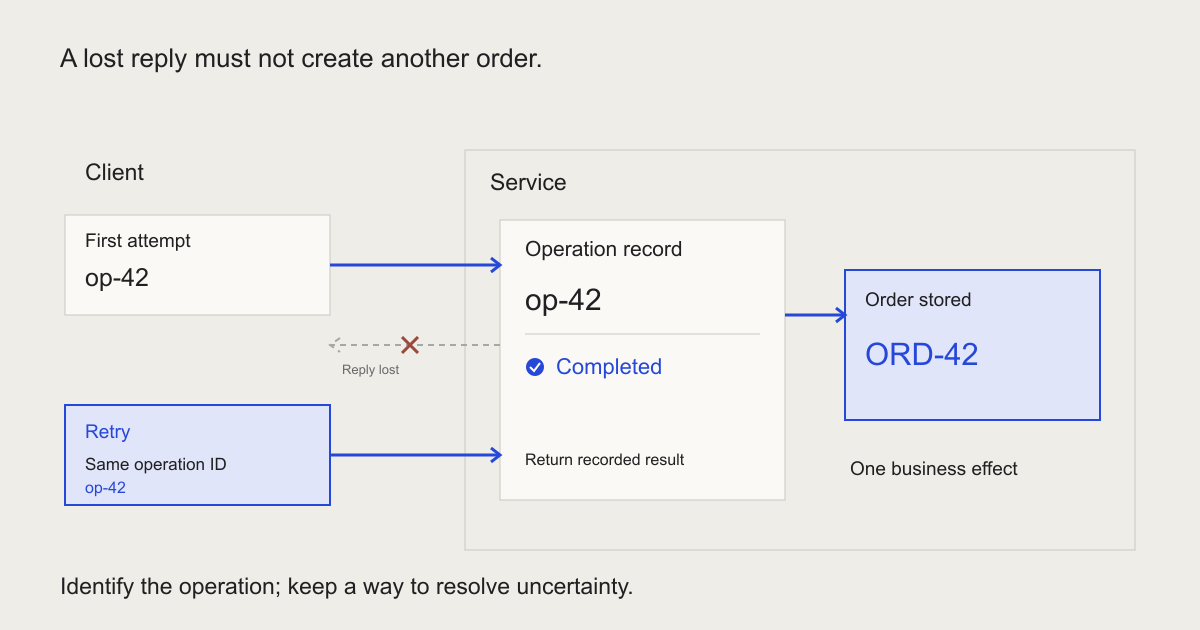
Consider an order workflow in a test environment. The service creates the order, but its reply never reaches the caller. The customer sees a timeout and tries again. If that creates another order, the retry policy has changed the customer's purchase. A server returning an error does not settle what happened to the work behind it.
This is a useful review for a founder connecting a new provider or an enterprise team changing an integration. I would ask for three things: a definition of one intended action, a tested limit on repeated attempts and a procedure for outcomes the system cannot yet confirm. Those decisions belong in the product's release criteria.
Decide what counts as the same action
Start with the customer's intention. Retrying one order after losing the reply should preserve that order. Buying the same item again is a new action, even when the amount and delivery address match. Agree on that distinction with product and support before choosing a technical mechanism. It determines what the interface can safely offer after a timeout.
Idempotency means repeated attempts at the same intended operation do not repeat its business effect. A request key helps identify that operation. Stripe's reference describes this mechanism and distinguishes its API v1 and v2 behavior. Treat each provider's documented contract as something to verify, including how long a key remains useful and what a repeated call returns.
Keep the identifier outside the retry loop
Ask the team to follow one operation identifier from the first submission through the HTTP client, background job and any manual replay. Create it before the first attempt and keep it for attempts representing that same intention. Generating a fresh key inside the retry loop turns each attempt into a different operation from the service's point of view.
Decide what happens when someone edits the order or presses a support tool's retry button. A changed purchase needs an explicit decision about whether it is still the same operation. Scope identifiers to the authorised customer and operation type; they do not replace access checks. Put the reference somewhere support can find it without asking the customer to reconstruct a network failure.
Ask what survives a process crash
Walk through the gap between applying the effect and recording completion. If the service creates an order and crashes before saving its operation record, a replay might not recognise the work. Where one database owns both records, ask engineers to demonstrate a design that commits them together and handles concurrent attempts. Have them show the stored records and the result of two concurrent attempts.
An external payment or fulfilment service creates another boundary. A local database transaction cannot by itself confirm what that provider did. Preserve the provider's reference and use its lookup or reconciliation facility where available. If the outcome remains uncertain, keep an explicit unresolved state with a controlled next step. Do not infer permission for another charge from the absence of a successful response.
Give the extra attempts a budget
Correctness is only half the review. List which layers retry and who owns the overall deadline. In a hypothetical configuration, three attempts in an application loop, each wrapping three SDK attempts, can produce nine downstream calls for one action. Ask for the effective policy in the deployed client, including version and configuration. AWS's current SDK reference explicitly separates opt-in 2026 behavior from the preceding behavior.
Choose the maximum waiting time and additional load the workflow can afford. Include a stopping condition, spacing between attempts and the point at which the interface hands over to an asynchronous status or support process. Use the provider's supported policy where it fits. Avoid adding another retry loop merely because it improves a happy-path demonstration; test the combined behavior under failure.
Test a lost reply after the write
Background delivery needs the same scrutiny. Amazon SQS documents that a standard-queue message can be delivered again. A queue acknowledgement and the customer's completed operation are different things to account for. Ask the team to show how a redelivered job finds the existing outcome and how unresolved work reaches an operator.
A test that fails before any work starts misses the difficult case. In a controlled environment, interrupt the response after the operation has been applied. Check the stored result, the next attempt and what the customer sees. Include these cases in the review:
- The reply is lost after commit; retrying with the original identifier preserves one business effect.
- Two attempts arrive together; the concurrency decision prevents two orders for the same operation.
- A worker stops after a provider call but before recording completion; recovery checks the existing operation before repeating the effect.
- An old job is replayed after its deduplication window; the team can explain the remaining protection or the required manual check.
Give support a usable unresolved state
A timeout message should give the customer a safe next action. That could be checking the existing order's status while the service verifies it. Product and support need to agree when another submission is appropriate. Assign unresolved outcomes to a named owner with a review deadline, an operation reference and an authorised recovery procedure. Make that procedure part of operating the integration.
For the release decision, I would look at unresolved operations, repeated effects, waiting time and the work support must do to reconcile failures. A high eventual-success rate alone can conceal duplicate work. Before enabling automatic retries, have the team demonstrate one uncertain outcome from the customer's screen through to its resolution. Use the demonstrated recovery as the acceptance check for that integration.