CTO commentary by Ilya Ilin
On October 21, 2026, the PHP project released fixes for two vulnerabilities known as PHP2Shell (CVE-2026-109618 and CVE-2026-109619). Both could let an unauthenticated request trigger code execution on a vulnerable server. The Wikimedia Foundation temporarily took supporting services including Toolforge and Cloud VPS offline as a precaution. Wordfence also reported its own site and several services temporarily unavailable while it applied mitigations.
Fixing the exposed runtime is the immediate decision. The architecture decision comes once you know how to secure it. If PHP needs to go offline again, what should visitors still be able to read or do? That answer tells you where a React migration would help and where to invest in PHP operations.
Choose what should stay online
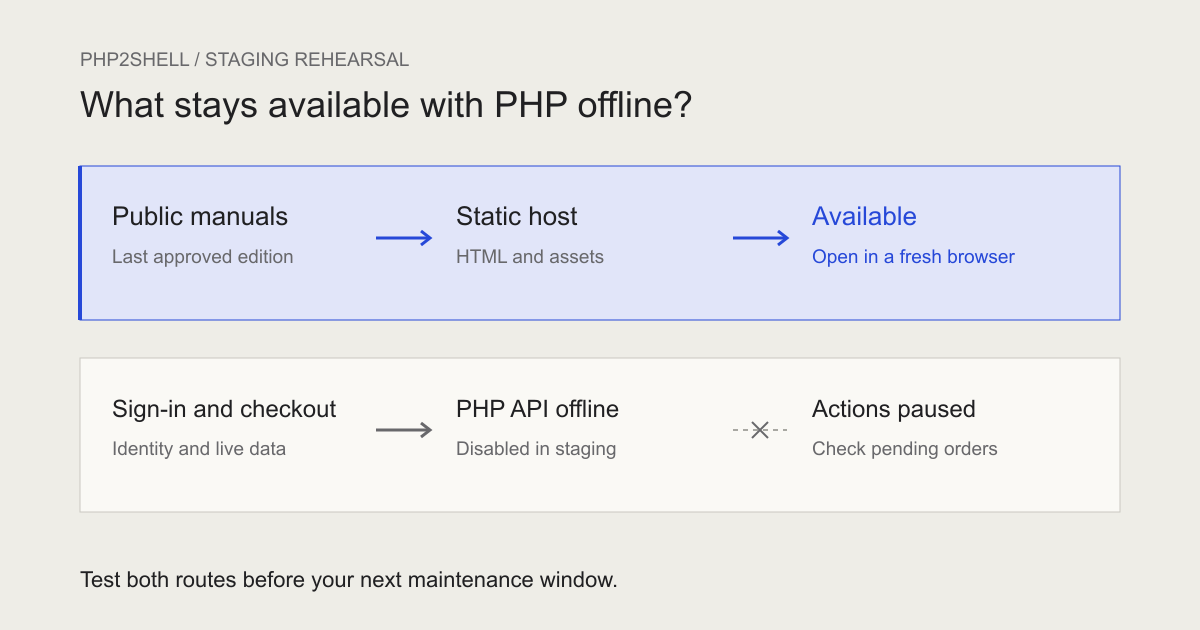
Imagine a parts distributor whose product pages, manuals and ordering portal all run on PHP. A technician may need a compatibility chart to finish a repair even when ordering is suspended. The chart and public manuals can use the last approved edition. Live stock, contract prices and order placement depend on current data and permissions.
List the public URLs customers need during an incident. Give each a freshness rule and decide what the visitor should see when data is unavailable. A public manual can show its revision date. A stock indicator can state that availability is temporarily unknown. Start with the page that is both valuable during an outage and safe to serve from a published copy.
Move one public route to static delivery
Next.js can turn React routes into HTML, CSS and JavaScript at build time. Serve the resulting files, images and downloads from a static origin that can answer requests while PHP is out of service. A new visitor should get the page even with an empty cache. Check every request on that route, including navigation and asset URLs, for calls to the unavailable origin.
A React team can share navigation and components with its authenticated product and release changes to the public pages on a separate schedule. Budget for the content publishing pipeline, redirects and the extra service to operate. Keep the last reviewed export available so a CMS outage or failed build leaves a usable version in place. Try the manuals first and keep their public URLs stable. Add more routes once the rehearsal shows which dependencies were actually removed.
Give sign-in and checkout a clear failure state
A static storefront can load while PHP is offline. Account access, live prices and payments still need services that can verify identity, permissions and current state. Keep customer data out of the public export and shared cache. When those services are unavailable, show which actions are paused and where the customer can see updates.
Test both failure timings. A checkout that fails before submission can show that nothing was sent. A request that times out after it reached the server needs a way to check the existing order or payment. Reconcile that operation before accepting a second attempt, so recovery does not create a duplicate order or charge.
Patch and isolate the PHP you keep
Map the PHP that serves requests, including separate pools, containers and admin routes. Use a maintained build your vendor confirms contains the fixes. A distribution can ship a backport under a different version label. After replacing or restarting workers, verify the runtime actually receiving web traffic against the advisory. A command-line version check only describes the binary it invoked.
Test a patched pool and shift traffic in stages once it is safe to do so. Remove vulnerable workers from public routing when continued exposure is unsafe. Use a firewall rule as a temporary measure while applying the update. Separate credentials, permissions and workloads so the failure of one pool has fewer routes and data stores to reach.
Host a status page and essential public documents outside the infrastructure you may need to isolate. Keep off-site backups under separate credentials, restore them into a clean environment and measure when a real customer workflow works again. Assign someone to own that recovery target and rehearse it before a patch day.
Turn off the PHP upstream in staging
Use test accounts and a payment sandbox. Make the PHP upstream unavailable in staging and open the public URLs in a fresh browser. Keep it unavailable until the team can demonstrate three outcomes.
- The public pages, manuals and status link load with an empty browser cache. Each page shows the freshness it can actually promise.
- Sign-in and checkout show a clear temporary state. A timed-out transaction can be checked after recovery without creating a second order or charge.
- The last approved public export can be restored independently. The team can restore the PHP service, verify its running build and record the time until an end-to-end transaction succeeds.
Fund the change that protects the customer journey
For the distributor, the manuals are a good first React route. Visitors can use them without accounts or live prices, and the team can test that result before touching ordering. If your product earns its revenue in a transaction that depends on PHP, budget for a supported runtime, isolated failure and a rehearsed restore first. A separately hosted status page is a small part of that work.
Compare the two investments against the same exercise. Write down the journeys that completed with PHP offline, the data the team had to withhold and the time it took to recover checkout. Use those results to decide whether another public route is worth moving.
Sources
- PHP project security advisory for the two October 21 fixes ↗ ·
- CERT-EU advisory on the critical PHP vulnerabilities ↗
- Wikimedia Foundation update on affected tools and services ↗ — Wikimedia Foundation ·
- Wordfence incident report on its temporary service shutdown ↗ ·
- Next.js documentation on static exports ↗