CTO commentary by Ilya Ilin
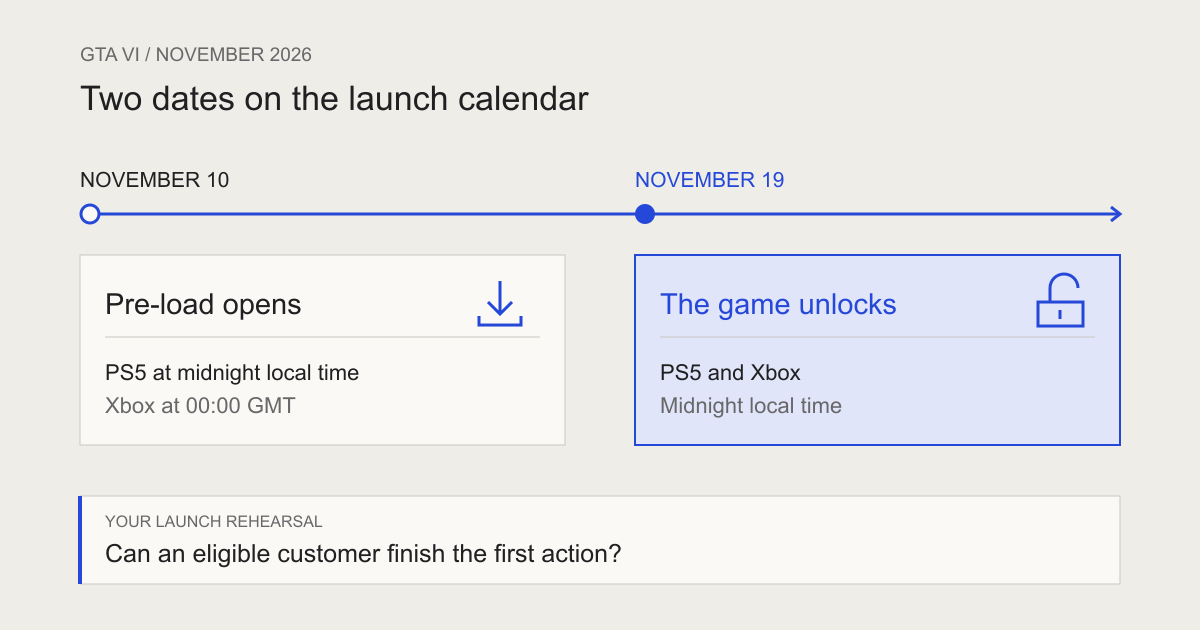
On November 10, players can start downloading the digital edition of Grand Theft Auto VI. The PS5 pre-load starts at midnight in each local time zone. On Xbox Series X|S it starts at 00:00 GMT worldwide, which is still November 9 in parts of the Americas. Rockstar schedules the game itself to unlock at local midnight on November 19 on both platforms.
Downloading and opening the game are separate events on that schedule. The useful question for a team with its own date on the calendar is what it can get out of the customer's way before that hour. A launch still needs a rehearsal for the work that cannot happen early.
Give delivery its own deadline
For GTA VI, a player can use the time before release to transfer the game files. For a desktop product, the equivalent might be downloading a signed installer. A web team could deploy a compatible release, put versioned static files on its content delivery network and prepare shared data before turning on a feature. Only move work forward when it can be delivered without exposing restricted content or weakening access checks.
Write down what happens if you have to replace what you shipped. A small patch can preserve the value of an early download. A late change that forces a full reinstall can send everyone back to the download at once. If you cannot support two versions safely, use the lead time for a small internal rollout and rehearsal instead of a public pre-load.
Name the first thing a customer must be able to do
Imagine a reporting product with a public release at 10 a.m. Its customers need to sign in, open their workspace and run the first report. Draw those steps and put the services they depend on underneath. An invitation email can go out earlier. Account access still has to be correct at 10. A report template can be prepared in advance, while a customer's run must respect their current permissions and data.
Agree with product and support on what counts as success. A green homepage is little consolation to someone staring at a spinning sign-in button. Track completed first reports, time to completion and users waiting at each step. Put recommendations or a welcome tour on a separate path if either can hold up the report.
Load-test the opening minute
In a hypothetical launch with 12,000 invitees, 3,000 arrivals over the first five minutes average ten per second. If 600 of those people arrive together in the first ten seconds, the rate for that interval is 60 per second. Each arrival may refresh a session, look up workspace access and submit a report. Size those operations against the burst and your providers' limits. These are example numbers for the reporting product.
In the rehearsal, start with a mix of new and expired sessions, old and current clients, and cold and warm caches. Run the whole sign-in-to-report journey at the assumed peak. Watch where people wait, how often a retry repeats expensive work and how long recovery takes when the load drops. A healthy average across five minutes can hide the ten seconds in which the system stopped making progress.
Decide how to slow the launch
If the date is fixed but the audience can be phased, open access in named groups and leave enough time between them to see whether the first group can finish. If everyone is promised the same opening, work out what you can queue and what must succeed immediately. A waiting room helps only if it admits customers at a rate the downstream services can finish. A place in line is useful when it survives a refresh and the wait is explained.
Give the on-call lead authority to pause invitations or disable optional work at a measured threshold. If the identity provider limits requests, make a temporary failure visible and slow retries instead of multiplying them. Google's SRE chapter on cascading failures explains how synchronized retries can keep an overloaded system down. When a report request times out after submission, let the client recover the status of that request before starting another one.
Run the dress rehearsal with support in the room
Use a clock, a test audience and the same sequence of switches you expect to use on the day. Assign one person to open access, one to watch the customer journey and one to publish the status message. Give each person the same go, pause and resume criteria. I would ask the team to demonstrate four things.
- An eligible customer can arrive with yesterday's client, sign in and complete the first action within the agreed time.
- Someone without access sees the correct reason. A valid customer who is waiting can tell that they have not lost their place.
- The team can pause new arrivals while existing sessions finish. A timed-out retry does not create a second report or a second charge.
- Support can explain the next step while the constrained service is still failing, and the on-call lead knows what evidence permits a restart.