
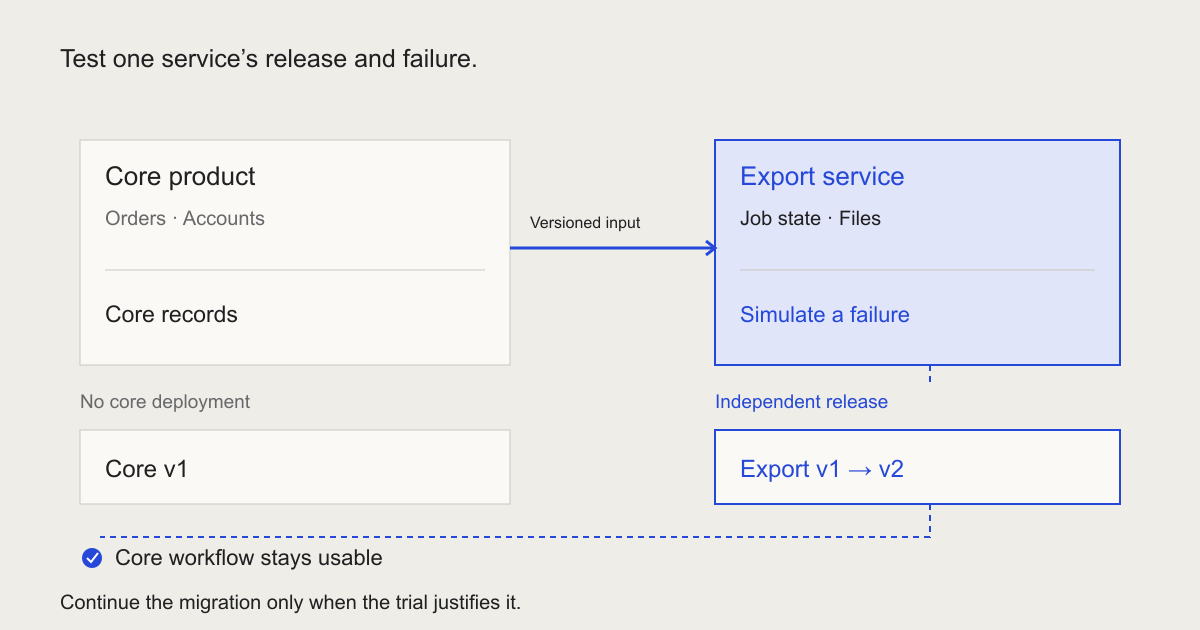
The engineering team proposes splitting the application into microservices. Releases should become faster, failures more contained and ownership clearer. Before approving the migration budget, ask for one demonstration: change a business capability, deploy it and recover from its failure while the rest of the product keeps running.
I would fund that first extraction as a decision with a stopping point. It should test a specific constraint in the current product. If the result is two codebases that still need a coordinated release, the team has learned something useful before committing to the rest of the migration.
Find where a change actually waits
Review recent changes with the people who delivered them. Separate time spent implementing from time spent waiting for review, a test environment, a release window or another team's work. A shared deployment might be the constraint. So might unclear requirements or an approval that takes longer than the build. A service boundary will not remove those delays by itself.
Write down the outcome the extraction must improve. That could be releasing reporting changes without waiting for the checkout release, or scaling a costly workload without replicating the whole application. Record the current behavior and the evidence you will compare afterwards. Do not use the number of new services as the success measure.
Choose a capability someone can own
AWS's decomposition guidance uses business capabilities as a way to find boundaries and stresses the need to understand the business. For a first extraction, I would look for a responsibility with recognisable users, a defined outcome and an owner who can make release decisions. Splitting the application into a database service, a validation service and an email service may simply spread one customer change across more teams.
Consider a hypothetical product whose large report exports delay interactive requests. An export service could accept a job, produce the file and expose its progress. This is a candidate to investigate, not a recommendation to move every export. Check how it obtains authorised data, which changes require coordination and what the product should do when exports are unavailable. If those answers are unsettled, clarify the module inside the existing application first.
Decide who can change each record
Microsoft's architecture guidance describes autonomous deployment and data ownership, alongside the extra complexity of distributed operation. Moving code into another repository does not establish either. In the export example, identify who owns the job state, where the input comes from and which component is allowed to modify it. Avoid a supposedly independent service that depends on undocumented queries into another component's tables.
Agree on an input contract that can survive different deployment dates. The core product might expose a versioned API or provide a defined data snapshot; choose according to freshness, volume and access requirements. Service-owned records do not automatically require a separate physical database server. The important question here is whether the team can change its implementation without silently breaking another consumer. Budget for authentication, monitoring, deployment and incident response as part of the extraction.
Ask for two releases and one failure
In a controlled environment, release an export change while leaving the core application on its existing version. Then release a compatible core change without redeploying exports. Run the customer workflow after each step. A pipeline that automatically redeploys both components can hide the dependency you are trying to remove; inspect the actual versions and records.
Next, make the export service unavailable. Can a customer still complete the core task? Can an accepted export be found, retried safely or explicitly failed? Check the waiting time, accumulated work and recovery procedure. Independence includes a useful response to partial failure. An application rollback must also be tested against the data and messages the newer version has already produced; switching the route back does not undo them.
Move traffic without losing the way back
AWS describes gradual replacement through the strangler fig pattern: old and new functionality coexist while routing moves work between them. Its guidance also calls out the routing layer's potential to become a bottleneck. This offers a migration structure, not proof that a particular cutover is safe.
Choose a bounded set of work and define what happens to jobs already accepted when routing changes. Avoid having both implementations perform the same customer action during comparison. Define rollback prerequisites, including which records the old path can still understand. Keep one authoritative write path for each operation, and make reconciliation someone's responsibility. Retaining the old code is useful only if the team can explain when returning to it remains safe.
Use the result to decide what to fund next
Compare the trial with the constraint you recorded at the start. Did the relevant changes spend less time waiting? Did interactive work stay within its target while exports were busy or unavailable? Include infrastructure spend and engineering time spent operating the additional service. One successful deployment is insufficient evidence for a whole migration.
I would use these checks at the review:
- The owning team can release a useful change without a coordinated deployment of the core product.
- The contract works across the supported version combinations, and the record owners are explicit.
- A controlled failure leaves the core workflow usable and the affected work recoverable or clearly failed.
- The demonstrated delivery or capacity benefit justifies the additional operating work.