
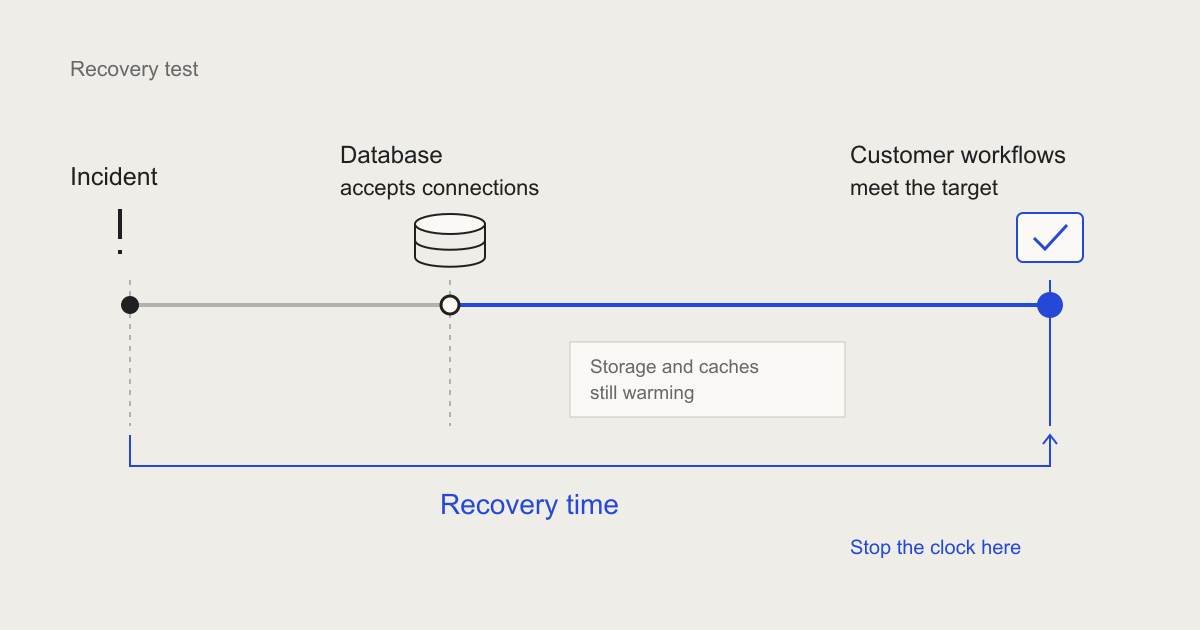
A restore rehearsal can pass while the checkout still times out. If the test ends when the database accepts a connection, nobody has established when customers can use the product again. That missing interval belongs in the recovery plan.
An AWS engineering article from 14 October describes RDS for PostgreSQL instances becoming available while snapshot data still loads on first reads. Recovery planning needs to include the customer’s experience during that interval. What does the team mean by “recovered”?
Choose the work that must resume
Start with a short conversation between the people running the service and the people responsible for customers. Which work must resume first? For an online shop, browsing a cached catalogue might be available while placing an order is still broken. An enterprise tool might reopen its dashboard but fail to save an approval. Pick a few complete workflows, including their writes, rather than a list of healthy components.
Give each workflow an acceptance condition: expected result, acceptable response time and traffic level. Keep the recovery-time objective, the target time to restore service, separate from the recovery-point objective, the acceptable amount of lost data expressed in time. A fast checkout using an old database may meet the first target while missing the second. Both need an owner who can accept the business consequence.
Rehearse from the state an incident leaves behind
For the exercise, restore a recent, representative backup into an isolated environment. Protect the data with the same care as production and disable real payments, messages and outbound jobs. Record the backup's recovery point and the time each recovery step completes. Avoid quietly preparing a warm database the night before: that removes part of the work the exercise is meant to measure.
A tiny test database can conceal the time spent moving data and loading working sets. Use a representative size and data distribution, with appropriate masking or synthetic data where needed. Record the differences you cannot reproduce, such as quotas or network capacity. The result is evidence for those conditions, not a universal recovery time.
Run the application before declaring recovery
Reconnect the application using the documented procedure, then run the agreed workflows. Check the account permissions, secrets, connection pools and background workers those workflows actually use. Submit a test order and find it again. Save an approval and read its audit entry. A successful database health check cannot answer those questions.
Build up a controlled workload and watch response times, errors and queue growth. A restored system may handle one request while falling behind as customers return. Keep the timer running until the agreed workload is stable. If part of the product remains unavailable, record that explicitly so customer support can explain what has and has not returned.
Also account for work around the recovery point. A payment provider may have accepted a payment that the restored database no longer knows about. Retrying everything can create a second side effect. The exercise should establish which records need reconciliation, how duplicates are prevented and who decides whether it is safe to resume processing.
Spend warming time on the important paths
When cold reads are the bottleneck, test a deliberate warm-up before admitting normal traffic. Start with the tables and indexes used by the priority workflows. PostgreSQL's pg_prewarm can load relation data into operating-system or database buffers. Its documentation also explains that warmed blocks can be evicted; loading more data than the cache holds does not make all of it stay warm.
That makes warm-up a workload decision. Reading every table may delay the work customers need first and consume the same I/O that the application needs. Compare targeted warm-up, gradual traffic return and the existing restore procedure under the same conditions. Choose from the measured time to usable service, resource cost and operational complexity. Do not turn a vendor's benchmark into your own recovery commitment.
Use the failed target to make a budget decision
If the measured recovery misses the business target, identify the slow stage before buying a second region or a larger database. Finding the right backup, obtaining access, restoring storage, warming the workload and reconciling records call for different fixes. Automating a manual approval can help more than increasing I/O when access is the delay.
A small product may reasonably accept a longer outage and keep a simpler recovery procedure. A service with time-sensitive transactions may need a maintained standby, rehearsed failover or a narrower degraded mode. Those choices bring ongoing cost and more ways to operate the system incorrectly. Put that cost beside the consequence of downtime and the team's ability to maintain the solution.
Leave evidence the next person can use
The useful output is a short runbook with the tested backup, environment assumptions, required access, workflow checks and measured times. Name the person who can declare recovery and the person responsible for customer communication. Include the reconciliation work left after service returns.
Rerun the exercise after a material change to data size, storage, dependencies or the recovery procedure. Keep the previous result so the team can see whether recovery is getting slower. The next discussion can then start with a specific gap and a proposed fix, rather than another assurance that backups are enabled.